
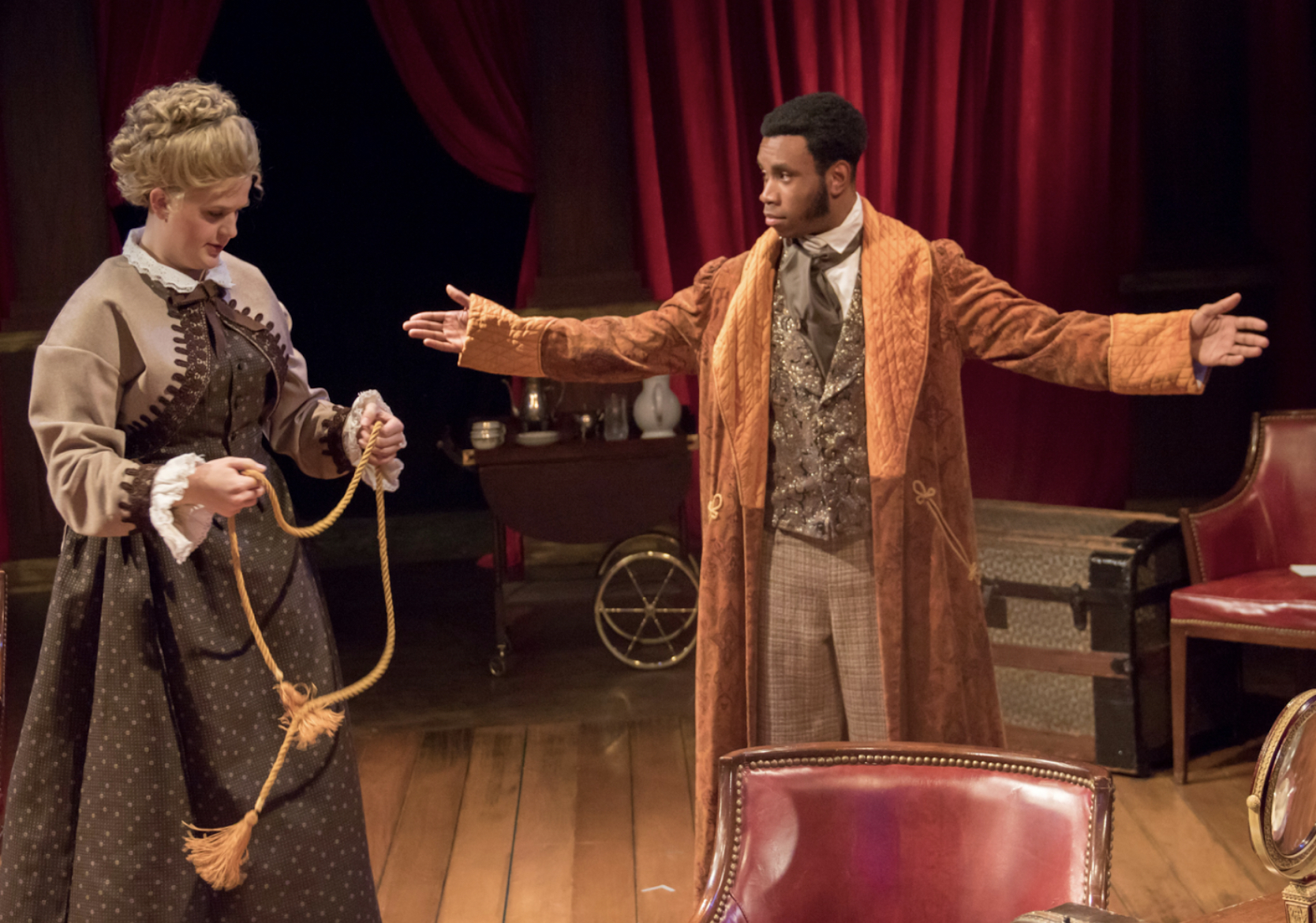
SCHOLARSHIP AUDITIONS
REGISTER ONLINE BY DECEMBER 15, 2026!
See below for further information.
WHAT ARE THE IRENE RYANS AUDITIONS:
The Irene Ryan Acting Scholarships provide recognition, honor, and financial assistance to outstanding student performers wishing to pursue further education. The Irene Ryan Foundation awards sixteen regional and two national scholarships annually. One nominee and partner from each region will be invited to the national festival, and the nominee will receive a $500 scholarship. The runner-up in each region will also receive a $500 scholarship.
The Irene Ryan Acting Scholarships are disbursed through a school designated by the winner, to pay tuition and fees for further education, not necessarily limited to theatre arts.
Students and coaches are encouraged to consult the Region 3 chair or the Irene Ryan Acting Scholarship Auditions coordinators for information on other regional awards.
For more information, contact Region 3 coordinators: Amy albudd@goshen.edu and Todd Quick TQUICK@monmouthcollege.edu.
Read carefully all information.
- All rounds of the scholarship auditions will be held in person at the Madison conference!
- All three rounds will be the same with a total package of 4 minutes to present one monologue and one scene.
- Self-submissions are allowed and there will be no difference between nominations and self-submissions. In order to be guaranteed that your nomination or submission is seen you must complete both the Irene Ryan registration and the Conference registration by December 15, 2026.
- Scholarship participants will still be able to partner with one other scholarship participant and must use a different scene for each package.
- Actors may appear in no more than two auditions. For example, you may audition yourself and also serve as someone’s partner, or you may serve as a partner for two others.
- Only those performers who are bona fide students during the festival year are eligible. Check the FAQ’s for student requirements.
- All scene partners must have been a bona fide student at the time of the initial CACTF response or during the term in which the regional festival occurs. Nominees and their partners need not be students at the same institution.
- Only students from institutions that had participating or associate productions with-in the last calendar year may be eligible for scholarships and awards.
In the PRELIMINARY ROUND, auditioners will perform one scene and one monologue totaling no more than four minutes. Students (auditionee and partner) must register and pay a registration fee to participate.
Students will be expected to arrive for their group time but will be dismissed after completing their session. Preliminary round feedback will be provided verbally following the round. Please note that all notes come from respondents and not the selectors in the room.
Forty-five (45) auditioners and their respective partners will advance to the SEMI-FINAL ROUND. Semi-finalists will perform their one-monologue, one-scene package again and will receive feedback from the Semi-Final Round Selectors in person.
Sixteen (16) auditioners and their respective partners will advance to the FINAL ROUND, which are made public to the full festival. Finalists will again perform their one-monologue + one-scene package. The order of the Final Round audition material will be determined by the students in consultation with their mentor(s). The Time limit is four (4) minutes total, including transitions.
One finalist and one runner-up will be selected by the Scholarship Selectors.
- Choosing material suited for the actor that reflects self-awareness, expressive emotional range, wide vocal range, and physical connectedness.
- Engaging in active objectives and tactics to affect how they are speaking to their real or imagined scene partner. (Acting is action: what is your objective? what/who is your obstacle?)
- Living truthfully in the moment of their given circumstances. (Who, what, where, when, why, and how?)
- Expressing a compelling story with a clear arc from beginning to middle to end.
- Demonstrating a connection with a real or imagined scene partner (i.e., who you are speaking to?), projected imagery, and specific fourth wall focal points.
-
Making a Body/Voice Connection. (Are you filling the space vocally, energetically, and in connection with your body? Can we understand you?)"
- Make strong, positive, and varied choices aimed at putting your character at the forefront of the scene.
- Locate and explore counterpoints and tensions between yourself and the character, tensions within the character, and tensions between the character and the dramatic situation.
- Take a journey and allow the text to surprise you. Use discoveries, realizations, unusual tactics, and nonverbal choices in the scene to keep the character’s journey spontaneous and surprising.
- Give movement specificity and dramatic validity. Simple but completely realized movements and gestures are the most effective. Avoid literal interpretations of the text in movement and gesture.
- Avoid working on too many physical levels (on chairs, tabletop, etc.) Look for staging choices that grow more from a thorough understanding of the text than a desire to use the audition venue in a unique and clever way.
- Maintain safe vocal practice throughout the scene. Don’t let emotions drive you into unsafe vocal practices.
- Imagine the physical space appropriate for your scene; set the environment and maintain it during the performance.
- Movement should develop organically from the material; the connection between the physical action and its emotional source should be strong and clear.
- Ask your acting teachers and your coaches to help you with your audition. Don’t let the regional festival be the first place your audition will be seen by others. Feedback from coaches and as much rehearsal in front of others as possible is essential.
- Your introduction is an important part of your audition. Make it count. Script and rehearse it as if it were an additional scene. Be sure both you and your partner are introduced by name (but do not identify your school) and that you identify the title and author of each piece you are performing. Keep the introductions brief, personable, and professional.
- Adequate rehearsal is vital. A five-minute presentation should be rehearsed for a minimum of six hours, excluding time spent learning the material and discussing it with coaches.
Audition material should be selected from the following:
- Public domain (non-copyrighted material).
- Material written for or by the candidate.
- Material for which permission of the rights holder can be secured.
To find the rights holder of a particular play, a good, though not perfect resource is www.findaplay.com. Some pieces are published for reading and study by publishers who do not control the performance rights. You will need to provide proof that you’ve secured performance rights to any pieces not automatically cleared. For example, all Dramatists Play Service except Albee and Beckett are automatically eligible for use at the regional level so you do not need hard copy proof, but different publishers have different rules. Be sure to check!
Click here and select Rights and Royalties
As with any copyrighted material, if you wish to use non-dramatic source material for your audition (i.e., a novel, short story, etc.), you must obtain written permission from the author or rights holder if required to perform the piece.
Once you receive written permission (if applicable), be prepared to submit A COPY to the Irene Ryan coordinator at the auditions (keep the original secured in your possession at the festival, as this is a legal document entitling you to perform the piece.)
KCACTF Region III Festival Registration
Irene Ryan Acting Scholarship Audition Registration Form
Contact
Amy Budd
Irene Ryan Co-Coordinator
Associate Professor of Theater
Goshen College
574-535-7393
albudd@goshen.edu
Todd Quick
Irene Ryan Co-Coordinator
Assistant Professor of Theatre
Monmouth College
309-457-2398
TQUICK@monmouthcollege.edu